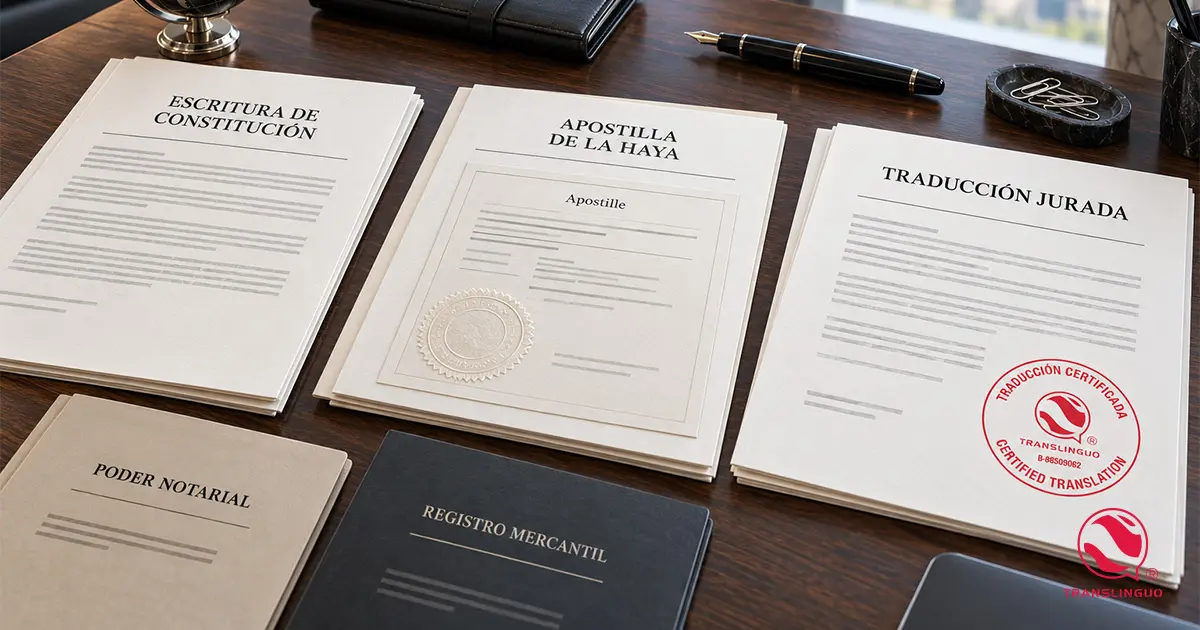
The legalisation of company deeds is the set of procedures—legalisation or apostille, occasionally certified true copies, and certified sworn translation—that turns articles of incorporation, a notarial power of attorney, or a deed of power of attorney into a valid document before a notary public, a commercial register, or an authority in another country. These are neither interchangeable nor optional steps: each addresses a distinct legal requirement, and omitting just one can bring the establishment of a subsidiary or the signing of a power of attorney to a complete standstill.
This article guides you through the real-world process of an expanding company—what to legalise in the country of origin, how to obtain an apostille under the Hague Convention, and when corporate certified sworn translation comes into play—complete with a decision table broken down by corporate document type.
At Translinguo Global, a professional translation agency, we have over 10 years of experience working with multinational companies, assisting them with every technical and legal process that requires translation. Our translators are native speakers with extensive experience, enabling us to deliver the highest quality guarantees and ensure that your filings comply with current legal regulations.
Legalising, apostilling, certifying true copies, and certified sworn translation: four distinct procedures
Confusing these four concepts is one of the most frequent causes of delays in multi-country corporate documentation. Each procedure certifies a different element, and a company may require all four for a single document, or just two, depending on the circumstances.
- Legalising: authenticates the signature, seal, or official capacity of the public officer or notary who issued the document, enabling it to be recognised in another country.
- Apostilling: the simplified method of legalisation, applicable solely between contracting parties to the Hague Convention, which replaces traditional consular legalisation.
- Certifying true copies: certifies that a copy is a true and faithful reproduction of the original document; it does not authenticate the document’s contents abroad, but merely confirms that the copy matches the original.
- Certified sworn translation: certifies that the content of the document—including seals, apostilles, and official notations—has been faithfully translated into another language, with legal validity before official bodies.
Does a power of attorney need an apostille and a certified sworn translation at the same time?
Yes, in most cases. A power of attorney executed in one country and intended for use in another requires first an apostille or legalisation to authenticate the signature of the issuing notary, followed by a certified sworn translation that faithfully reflects the entire content—including the apostille itself—into the language of the destination country. Translating the power of attorney before having it apostilled is one of the most frequent mistakes: the translation will be incomplete because it will not include the apostille, which is attached afterwards.
The actual process: what to legalise in the country of origin before translating
When an SME establishes its first subsidiary abroad, the order of steps matters just as much as the steps themselves. Disrupting the sequence forces you to repeat stages and drives up the cost of a process that, when properly planned, can be completed within a reasonable timeframe.
The first step always takes place in the document’s country of origin: the deed of incorporation, power of attorney, or certificate of good standing / commercial register extract must be legalised or apostilled there, not in the destination country. If both countries are signatories to the 1961 Hague Convention, searchable via the official database of the Hague Conference on Private International Law (HCCH), an apostille issued by the competent authority in the country of origin is sufficient. If the destination country is not a party to the convention, consular legalisation is required—a process involving more steps and longer turnaround times. Only after the document has been apostilled or legalised does it make sense to proceed with the certified sworn translation, as the translation must also include these endorsements.
Corporate documents, legalisation procedures, and the need for certified sworn translation
Not all documents involved in corporate expansion follow the same route. This table outlines, for the most common documents, which legalisation procedure applies and whether a certified sworn translation is also required for legal validity in the destination country.
| Corporate document | Legalisation procedure | Certified sworn translation required? |
| Deed of incorporation / Articles of association | Apostille (or consular legalisation if no convention applies) | Yes, always, for registration with a foreign commercial register |
| Notarial power of attorney | Apostille on the notary’s signature | Yes, including the apostille in the translation |
| Deed of power of attorney | Apostille or legalisation depending on destination | Yes, when exercised before a foreign notary or register |
| Commercial register certificate / Extract | Apostille (recently issued certificate, typically <3 months) | Yes, if the country requires a different official language |
| Simple uncertified copy for internal group use | Typically does not require an apostille | Depends on intended use; a standard professional translation is often sufficient |
| Annual financial statements for foreign subsidiary | Apostille if submitted to the local commercial register | Yes, if required by the destination country’s commercial register |
Can the same certified sworn translation be used across multiple countries?
Not necessarily. A certified sworn translation completed by a translator appointed by the Spanish Ministry of Foreign Affairs is valid in Spain and is, in practice, usually accepted in destination countries if the language matches the local official requirements. However, if the same deed must be submitted in two countries with different official languages—for instance, for subsidiaries in Germany and Portugal—each country will require its own certified sworn translation into the relevant language, produced by an authorised translator for that jurisdiction. There is no such thing as a “multilingual” certified sworn translation that is universally valid in all destinations at once.

One of the greatest sources of uncertainty during an initial corporate expansion is how much time and budget to allocate for the entire procedure, especially when the date for incorporation or signing before a foreign notary is already set. Turnaround times vary depending on the country of origin, the body issuing the apostille, and the target language of the translation.
- Apostille in Spain (via Territorial Justice Offices or electronically): typically between 24 hours and several working days, depending on the issuing authority and application volume.
- Consular legalisation (non-signatories to the Hague Convention): a lengthier process that can take several weeks, as it depends on the appointment schedule of the relevant consulate or embassy.
- Certified sworn translation of a standard deed of incorporation or power of attorney: between 24 and 72 hours under normal conditions, longer if the document contains extensive annexes.
- Full procedure (apostille + certified sworn translation) for a standard corporate document: between 3 and 7 working days, except for consular legalisation, which substantially extends the timeframe.
For transactions with a set signing deadline, it is advisable to begin the process with sufficient lead time to absorb potential delays during the apostille phase—the stage over which translation providers have the least control, as it relies on external public authorities.
Common mistakes in multi-country document processing
Beyond theory, most delays observed in international corporate expansions follow a recognisable pattern. Identifying these pitfalls before initiating the process saves weeks of administrative hassle.
The professional point of view: The costliest mistake we see among SMEs opening their first foreign subsidiary is not failing to realise that an apostille or sworn translation is needed, but underestimating the validity periods of certain certificates. Many foreign commercial registers require certificates from the home register to have been issued within a maximum timeframe—often three months—at the moment of filing. If a company apostilles and translates the document months in advance “just in case”, it may reach the destination register with an expired certificate, requiring the entire procedure to be repeated from scratch: re-issuance, re-apostille, and a new certified sworn translation. We always recommend synchronising certificate issuance with the actual filing date, rather than the project kick-off date.
How we manage the legalisation of company deeds at Translinguo Global
A well-managed legalisation process for company deeds combines in-depth knowledge of applicable international conventions, precise scheduling, and certified sworn translations into the exact language required for each destination. Here is our proven process for SMEs, corporate service agencies, and legal departments managing multi-jurisdictional expansion.
- Review of document and destination country to determine whether an apostille (Hague Convention) or consular legalisation applies.
- Verification of validity deadlines for commercial register certificates, preventing you from apostilling or translating documents that will expire before submission.
- Coordination of apostille or legalisation in the country of origin prior to starting any translation work.
- Certified sworn translation by destination language, handled by accredited translators for each jurisdiction when operating across multiple countries.
- Delivery in the format required by each commercial register or notary, ensuring terminology consistency when the same document is translated into multiple languages.
This process is supported by our certified sworn translation services, and is complemented by our detailed guidance on apostilling and legalising foreign documents and what certified true copies are. For partners or directors managing deeds in an individual capacity, you can also consult deed translation for foreign nationals; if your expansion combines corporate documentation with marketing collateral, our translation for exporting companies service covers that complementary phase.
The order of procedures determines whether your expansion moves forward or stalls
The legalisation of company deeds is not an isolated administrative task, but a sequence where each step depends on the previous one: legalising or apostilling at source, verifying certificate validity periods, and only then obtaining a certified sworn translation into the exact language required by each destination country. Disrupting that order, or assuming that one sworn translation works everywhere, turns a well-planned expansion into months of avoidable delays. As a translation agency with extensive expertise in multi-country corporate documentation, Translinguo Global coordinates the entire circuit, not just the translation.
If your company is managing corporate documentation across multiple subsidiaries or jurisdictions, explore our certified sworn translation services for comprehensive end-to-end management of your international document workflow, from initial review to certified delivery at every destination.