GPSR translation: safety labels and warnings in the EU
Since December 13, 2024, the General Product Safety Regulation (EU) 2023/988 (GPSR) applies. If you sell non-food consumer products in the EU, the instructions and safety information must be in a language easily understood by consumers, determined by each Member State where the product is marketed. And in online sales, the offer must show the details of the manufacturer or responsible person in the EU, the product identification and the safety warnings. In practice, GPSR translation covers four blocks: warnings, instructions, responsible operator details and online listing in each language of sale.
It is not about translating more, but about translating what the regulation requires and keeping it consistent across every SKU and every channel. At Translinguo Global, translation agency, we have been working with professional companies for over 10 years and perfectly understand the technical requirements that GPSR translation demands. Our ISO Quality certificates guarantee the quality and professionalism of all our translations.
Below, we explain the scope, what is translated country by country, how we organize the workflow, and what errors we see in marketplaces and manufacturers.

What the GPSR requires and which products it affects
The Regulation (EU) 2023/988 replaces the old General Product Safety Directive and extends its scope to distance selling. It applies to non-food consumer products, new, used or refurbished, marketed in the EU, even when the seller is located outside of it.
Excluded, among others, are medicines, food and feed, live plants and animals and antiquities. Furthermore, when a sector regulation regulates the same safety aspects, as occurs with toys, cosmetics or medical devices, that regulation prevails and the GPSR only covers what it does not regulate. The European Commission website on the GPSR summarizes these obligations for each operator.
What does GPSR Regulation say about language?
GPSR Regulation does not establish a single language: it requires instructions and safety information to be in a language easily understandable for consumers, determined by the Member State where the product is commercialized. In most cases that means the official language of the country, and in States with several official languages it is convenient to confirm the national criteria before printing. In GPSR translation we always start from that criterion per market, not from a generic list of languages, so as not to over-translate or leave a country uncovered.
How does it differ from translating data sheets, manuals or health labeling?
The translation of catalogs and product data sheets aims to sell; the translation of technical manuals is intended for industrial use; and the labeling of cosmetics, medicines or medical devices follows its own regulations. GPSR translation focuses on mandatory safety and traceability information, and it is the one that can cost you your listing if it is missing.
What is translated in GPSR translation
The obligation affects the physical product and its online listing. For a manufacturer or importer with multiple markets, GPSR translation comes down to a specific list of texts that must exist in each sales language and match across channels.
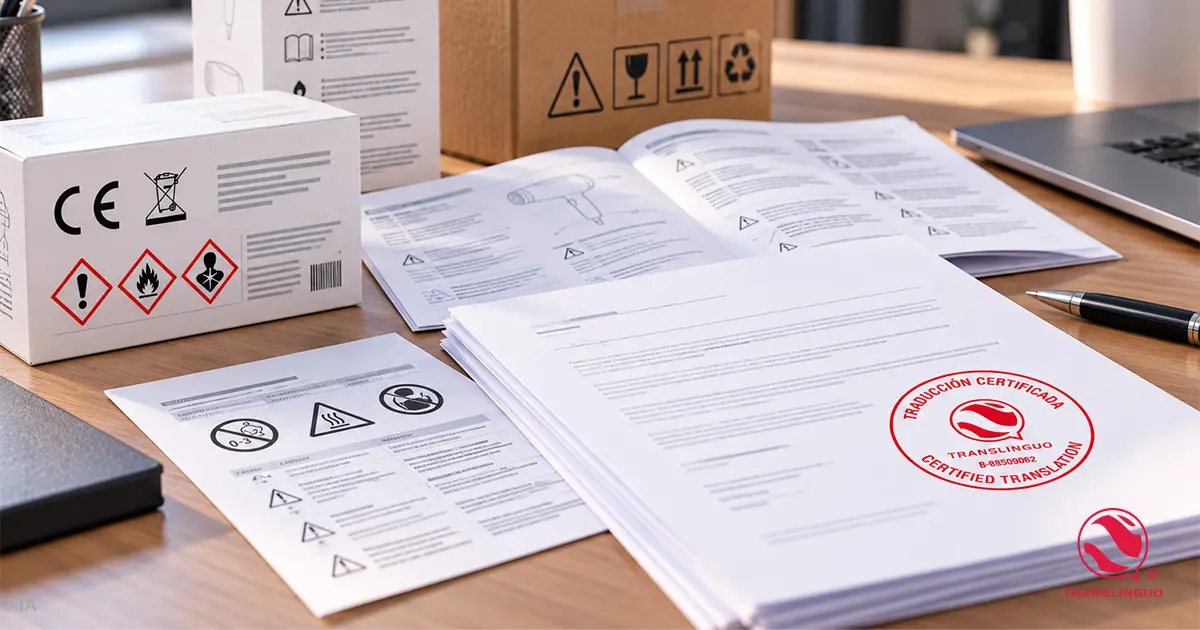
- Safety warnings: risk phrases, precautions for use, recommended ages and pictograms with text.
- Instructions: assembly, use, maintenance, and disposal; the translation of product instructions is mandatory when they are necessary for safe use.
- Responsible operator details: manufacturer, importer or responsible person in the EU, including a postal and electronic address.
- Product identification: type, batch or serial number and its description.
- Online listing: the same details and warnings visible on the own store and on each marketplace.
Warnings are the most delicate part of safety warning translation, because an ambiguously translated warning may fail to fulfill its purpose. That is why we treat it as technical translations with a fixed glossary, not as commercial text.
GPSR labeling by country of sale
Each Member State determines which language it considers understandable for its consumers, and platforms apply this criterion in their reviews. This table summarizes the most common markets for Spanish companies; before launching, it is advisable to verify the specific national requirements, for example with the European Commission’s Access2Markets.
| Country of sale | Required language | Where it must appear | Risk if missing |
| Spain | Spanish (also required by national labeling regulations) | Product or packaging, instructions and online listing | Listing block and authority request |
| France | French (Toubon Law on the use of French) | Product or packaging, instructions and online listing | Listing block and authority request |
| Germany | German | Product or packaging, instructions and online listing | Listing block and authority request |
| Italy | Italian | Product or packaging, instructions and online listing | Listing block and authority request |
| Portugal | Portuguese | Product or packaging, instructions, and online listing | Listing block and authority request |
| Netherlands | Dutch | Product or packaging, instructions and online listing | Listing block and authority request |
| Belgium | Languages of the linguistic region (French, Dutch, German) | Product or packaging, instructions and online listing | Listing blocked and authority requirement |
GPSR labeling does not require reprinting everything in every language: many companies use multilingual labels or inserts per market. The important thing is that each country’s information is complete and identical to what appears on the online listing. Sanctions are set by each Member State, but the immediate risk is usually commercial: the platform blocks the listing until it is corrected.
Does the marketplace listing need to be translated too?
Yes. Article 19 of the regulation requires the online offer to displays the manufacturer’s details, product identification and safety warnings in the language of the country. This is the most frequently overlooked aspect: the label is translated, but the listing is not, and GPSR translation remains incomplete.
Our GPSR translation workflow by SKU
With dozens or hundreds of references, the risk is not mistranslating a phrase, but rather having the same warning appear in three different versions or leaving an SKU outdated. That is why we organize GPSR translation as a document control workflow, not as a one-off assignment.
- Text extraction from labels, inserts, instructions, and online listings.
- Warnings glossary by language, validated with the client and reusable across products.
- Translation by a native professional translator with technical experience.
- Technical review of warnings, pictograms and units.
- Version control by SKU, to know which text corresponds to each reference and market.
- Delivery in printing and platform upload formats.
We work in Phrase with translation memories and an ISO 17100 certified workflow, which allows for the reuse of already validated warnings and reduces costs for each new product: in a large catalog GPSR translation , reuse is usually the factor that most influences the budget. For large catalogs, this workflow integrates with our e-commerce translation.
What we analyze before quoting a GPSR translation
Most companies come to GPSR translation reactively, after a marketplace notification. Before quoting, we review the catalog and channels, as the actual volume rarely matches the number of products.
What we analyze in the first consultation
- Sales markets and channels: own store, marketplaces and distributors.
- Number of SKUs and how many warnings they share.
- Available source texts and which language they are in.
- Output formats: label, insert, data sheet or bulk upload file.
Warnings that only exist in English
This is the most common situation for importers: the manufacturer provides warnings only in English, sometimes translated from a third language. In such cases, we first review the source text, because translating a confusing warning multiplies the error in every language. If the original is ambiguous, we propose a clear drafting to the client before starting the GPSR translation into the remaining languages.
Common mistakes
- Translating warnings using machine translation without a technical review.
- Forgetting the online listing when the label is already translated.
- Using different versions of the same warning depending on the SKU.
- Omitting the electronic address of the responsible operator.
When does GPSR translation not apply?
When the product is excluded from the regulation, such as food or medicine, when a sector-specific regulation governs the same aspects or when you only sell to businesses and the product is not intended for consumers nor is it likely to be used by them. When in doubt, it is advisable to confirm this with the compliance officer.
A typical case: a garden supplies seller with 140 SKUs across three marketplaces received notifications in France and Germany. Upon extracting the texts, we verified that the 140 references shared 23 warnings. Translating and validating that glossary resolved most of the work before moving on to the listings and reduced GPSR translation to a fraction of the initial word count.
Selling in the EU: translation with guarantees
When the objective is to sell in the EU, translation and compliance go hand in hand. As a translation agency, we combine technical knowledge of warnings with the ability to manage large catalogs in multiple languages simultaneously.
If you also export outside the EU, check out our translation for exporting companies and translation for import and export. For highly specialized texts, we have our specialized translation service, and if you are unsure about the type of service, it will help you to know what type of translation your company needs.
How much does GPSR translation cost?
It depends on the languages, the number of SKUs and, above all, how many warnings are repeated. As a translation company, we will send you a quote within 24 hours with the reuse savings already calculated.
Safety is also translated
The GPSR has turned safety information into a requirement for selling, and in online sales the listing matters just as much as the label. A well-organized GPSR translation protects your customers and keeps your listings active in every market.
If you have received a marketplace notification, request a quote and we will get back to you in less than 24 hours. If you are an e-commerce agency managing listings for clients, contact us to work with a stable workflow. And for the rest of your international documentation, check our translation services for companies. At Translinguo Global, a translation agency, we help you internationalize your business with the highest guarantees and quality.