

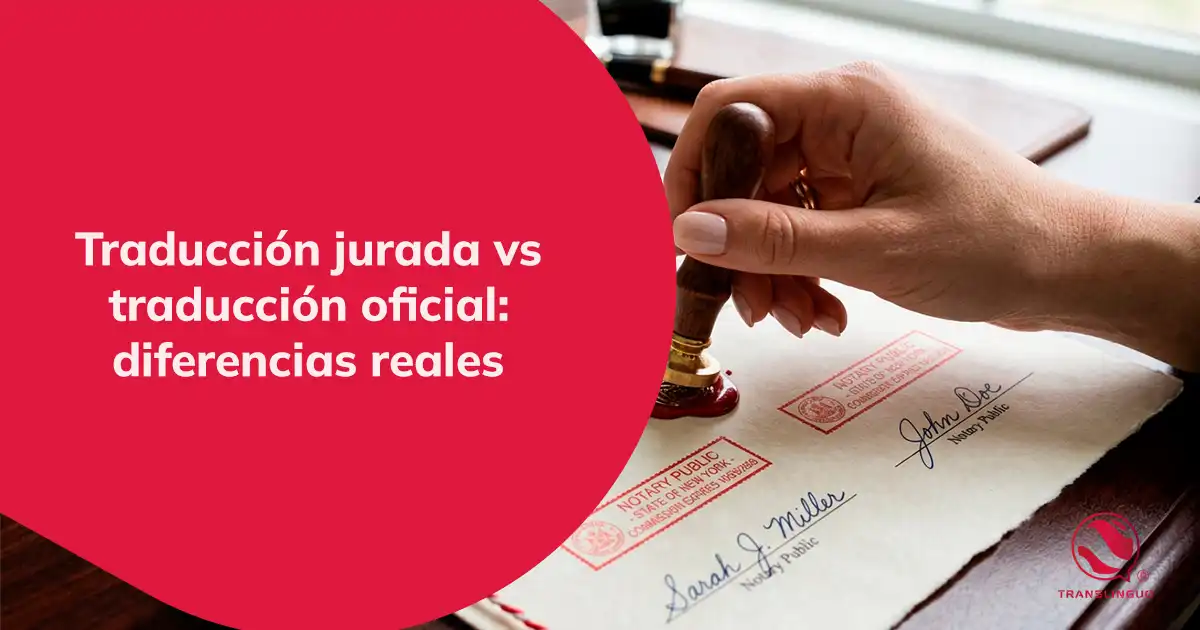
If you’ve searched for “official translation” online, it’s very likely you’ve ended up even more confused than before. Some websites use it interchangeably with sworn translation, some present it as a “translation for administrative purposes” (without certification), and others talk about “certified translation” without explaining who certifies it or to whom the translation is valid.
This confusion is not just a matter of terminology: it can cost you time and money. Usually it goes like this: you submit a translation that is “correct” from a linguistic point of view, yet the authority rejects it because they needed a sworn translation. Result: request for resubmission, delays, and duplicate payment.
In this article we will clarify, from a legal and practical perspective, what is a sworn translation in Spain, how the term “official translation” is used in practice (depending on the authority), and what you need to request for your document to be accepted without any issues.
At Translinguo Global, translation agency, we have expert sworn translators who ensure that your translations are delivered and accepted with the utmost guarantees by public and private authorities. Request your translation quote.
Why is There So Much Confusion Between “Official Translation” and “Sworn Translation”?
The confusion usually stems from the common use of the word “official” for anything that is “valid for official procedures”. But, legally, a correct and well-done translation is not enough, as who does the translation, if it is certified, and how it is going to be submitted are also important factors.
Besides, some authorities use the expression “official translation” in their instructions but then list several ways to obtain one, such as a translation by a sworn translator, a consulate, or an official translator based abroad whose signature has been legalised. One clear example is the Ministry of Education, which states that an official translation of academic documents can be carried out by a sworn translator in Spain, a diplomatic or consular mission, and an official translator based abroad with a legalised signature.
For this reason, the relevant question is not “which term is the correct one?”, but rather: “What will the receiving authority accept for my specific application?”
Official Translation and Sworn Translation: Are They the Same?
Sometimes they are the same (in everyday conversations and business context), and sometimes they are not (in specific instructions where “official translation” covers several areas). The safest way to approach it is to check the receiving authority’s requirement: if it requires a sworn translator or a certification with a signature and a stamp, you will need a sworn translation, but if it allows an official translation by a consulate or other means, there are other alternatives.
What is a Sworn Translation in Spain
In Spain, a sworn translation is tied to the role of the sworn translator or interpreter. The Royal Decree 724/2020 (BOE) defines sworn translators and interpreters as professionals who were awarded their title by the Ministry of Foreign Affairs, European Union and Cooperation (MAEC) after passing exams or through the recognition of qualifications.
That same regulation stipulates that translations carried out by individuals holding this title must meet specific requirements regarding stamps, certification, and verification of the authenticity of the original in order to be officially recognised. The regulation also states that the sworn translator certifies the accuracy and completeness of the translation with their signature and stamp, and that there is a register and a registration number for each sworn translator.
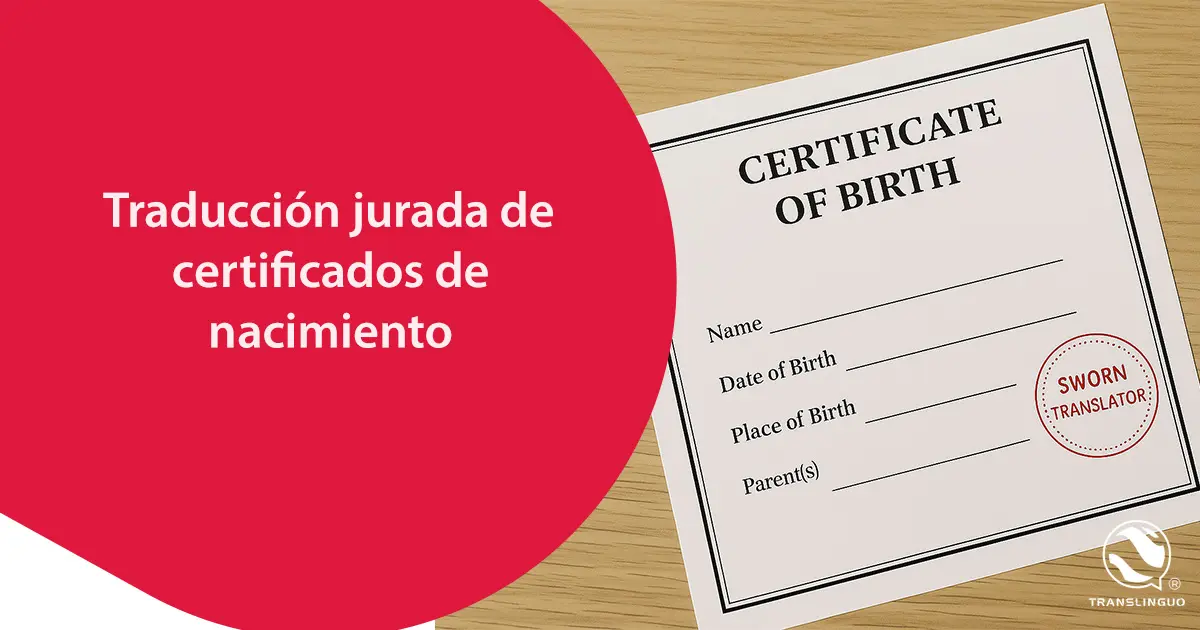
In other words: A sworn translation is not just a translation; it’s one with formal certification (statement of accuracy), a signature and stamp (or other mechanisms provided for by the applicable regulations), and identification of the qualified translator.
Who Can Sign and Stamp a Sworn Translation?
A sworn translator or interpreter with a title awarded by MAEC (and with their stamp and signature verified in accordance with the procedure). The regulation states that these official translations must comply with requirements regarding stamping and certification in accordance with the regulations.
What does “Official Translation” Mean in Practice? And Why Does it Depend on the Authority?
Here’s the important point: “official translation” is not always automatically the same as “sworn translation“.
- In many contexts – especially in service marketing – “official translation” is used as a synonym of “sworn translation” because that’s what immigration authorities, notaries, courts, or registry offices tend to request.
- In specific administrative instructions, “official translation” can mean “formally accepted translation”, allowing several options: sworn translator in Spain, diplomatic or consular mission, or official translator based abroad with a legalised signature (depending on the circumstances).
A typical example is the academic field. For academic documentation, the Ministry of Education sets out these methods of obtaining an “official translation” into Spanish.
At Translinguo, official translation agency, the first step when a client requests an “official translation” is to confirm the receiving authority and the document to translate to avoid paying for a sworn translation when it is not needed, or submitting a non-sworn translation when it was essential.
If a University Requests an “Official Translation”, is a Non-Sworn Professional Translation Enough?
It depend on the university and the procedure. Some universities accept official translation by a sworn translator, consulate or official translator based abroad whose signature has been legalised, as described in administrative guidelines for academic documentation.
If it doesn’t specify the type of translation, it is advisable to request written confirmation from the receiving organisation or to send them the exact requirements so that we can advise you on which option is most suitable.
Sworn Translation vs Official Translation (Validity, Signature, Format, Deadlines, And Cost)
| Subject | Sworn Translation (Spain) | “Official Translation” (Practical Use) |
| Definition | Certified translation by a sworn translator or interpreter (MAEC) | Variable term: sometimes synonym of sworn translation; sometimes “valid for official procedures” with alternative methods |
| Who signs it | Registered sworn translator or interpreter with an identification number | Can be a sworn translator, consulate or embassy, or an official translator based abroad with a legalised signature (as required by the instructions) |
| Common Validity | Registration with public authorities, notaries, courts, and registry offices | Depend on the organisation: it may require sworn translation, or accept other methods |
| Requirements | Certification of the original, signature and stamp, and a copy of the original (as required by the regulations) | Depends on the channel: consular, legalisation, etc. |
| Most common use | Immigration, nationality, civil registration, courts, notaries | Recognition/validation procedures, universities, or other processes that require an “official translation” |
| Risk of rejection | Low as long as it meets the requirements | Variable: if “official” is understood as “simple”, there’s a risk of rejection |
Choose Quickly Based on the Procedure: If Your Case is X, You Usually Need Y
These decisions tend to work in practice (with confirmation with the receiving organisation):
- Immigration (residency, nationality, arraigos – residence permits based on ties, etc.) → typically requires a sworn translation of foreign official certificates.
- Civil Registry (marriage, birth certificate, death, civil status) → Usually requires a sworn translation.
- Notary (powers of attorney, deeds, inheritances) → Usually requires a sworn translation.
- Courts and legal proceedings → Usually requires a sworn translation.
- Universities, degree recognition, credential validation → they typically require an “official translation” and may accept different methods according to the instructions (sworn translator, consulate, etc.)
- HR and compliance (international employee/supplier documentation) → depends on its use: sworn translation if its submitted to a public organisation; professional translation may be enough if its for internal use.
If you would like us to confirm the type of translation in 5 minutes, send us your document and the receiving organisation, and our sworn translators will analyse it and provide you with a quote tailored to your needs.
Format and Requirements: Stamp, Certification, Copy of the Original, and Digital Delivery
Another source of confusion: “Does it need a stamp?” and “is a PDF enough?” The regulations govern the sworn translator’s stamp and certification, and how the authenticity of the original must be verified (for example, along a stamped and dated copy on all pages in certain cases).
In practice, what causes the most problems is not the translation itself, but:
- Incomplete documents (missing reverse side, missing pages, missing apostille).
- Illegible scans.
- Mismatched names and dates between documents.
For this reason, it is advisable to review the original document and its legalisation/apostille status, where applicable, before ordering a sworn translation.
Is a Sworn Translation Valid if I Submit it Online?
Online documents are submitted in many procedures. The key point is compliance with the formal requirements of sworn translations (certification and required elements), and that the original is complete and verifiable. The regulations define requirements regarding stamp and certification so that it has official status.
If your organisation has a specific requirement (for example, a particular electronic format), it is advisable to validate it beforehand.
Common Errors That Result in Rejection (and How to Avoid Them Before Overpaying)
These are the most common mistakes that occur when “official” is confused with “sworn”:
- Submitting a simple translation when a sworn translation was required.
- Ordering a sworn translation without the apostille when it is required, and then having to redo the translation.
- Only sending the “important part”, excluding stamps/marginal notes.
- Names and surnames spelled differently across passports, certificates and resolutions.
- Blurry or Cropped PDF: The translator can translate, but the organisation may not accept due to illegibility of the original.
If you want to avoid unnecessary costs, the best course of action is to confirm the requirements before placing an order. This prior verification is precisely what we offer, so you neither overtranslate nor undertranslate.
What Happens If My Name or Surnames Does Not Match Across Documents?
It is a common cause of requests for resubmission. A sworn translation must faithfully reflect the content of the original document. In cases of inconsistency, supporting documentation or clarifications may be required, depending on the procedure. What matters is detecting it before submission, not afterwards.
How To Place An Order Without Making a Mistake: What to Send, Who It Is For, and How to Reduce Processing Times
To quickly confirm whether you need a sworn translation or if a professional translation is sufficient, please send:
- Complete document (including all pages, front and back, stamps, apostilles if there are any).
- Receiving authority (Immigration, university, notary, court, etc.).
- Issuing country and language of the document.
- Real processing time and whether submission is online or in person.
What Should I Attach So You Can Confirm The Type of Translation on First Contact?
The complete document and receiving authority. In many cases, the requirement is not within the document itself, but in who will receive it. If you also attack the link or screenshot of the requirement (if you have it), the confirmation will be much faster.
The objective is not to just “translate”, but to ensure it is accepted on first submission.
The difference between sworn translation and “official translation” is not resolved by generic definitions, but with a practical question: “What will my organisation accept?”. In Spain, sworn translation has a clear regulatory basis (sworn translator certified by MAEC, formal certification and requirements). In turn, “official translation” can be synonym to informal, or an administrative term that includes several methods depending on the procedure.
If you are in a hurry, the most effective approach is to avoid the classic mistake: submitting a “standard” translation only to later discover that you actually needed a sworn translation. At Translinguo, translation agency, we make it easy for you: send us your document and the receiving organisation, and we will confirm what you need (free of charge), so you can avoid rejections and unnecessary costs.
Request your free translation quote and our sworn translators will take care of ensuringthe successful submission to official institutions.