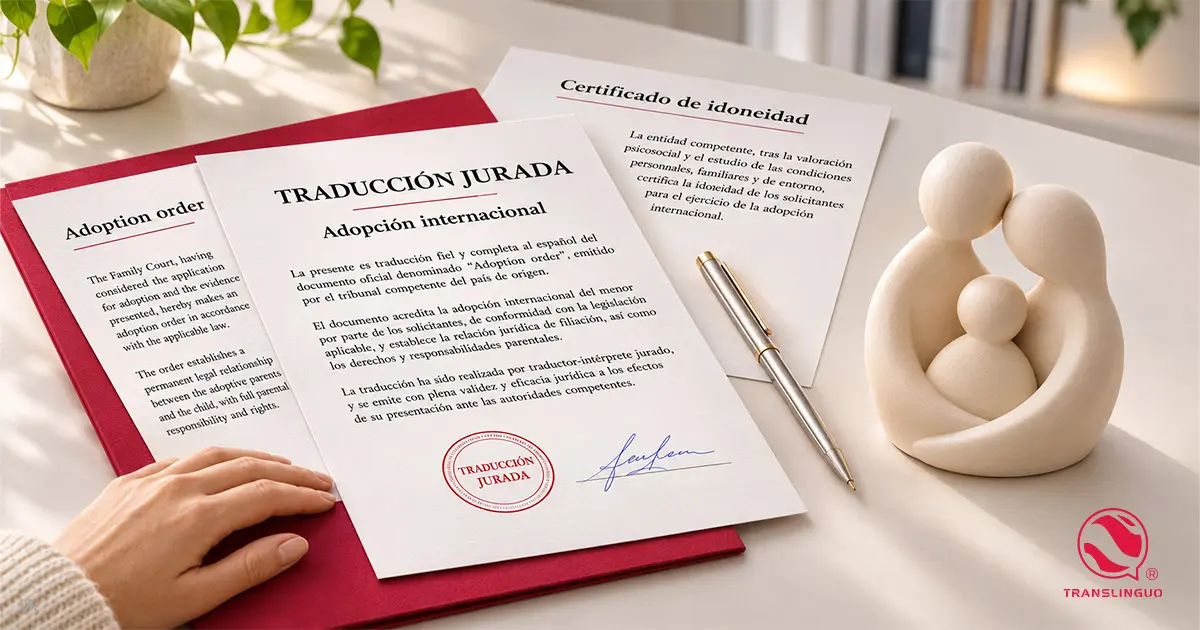
At Translinguo Global, an official translation agency, we’ve spent years supporting Spanish families through international adoption processes, with translators accredited by the Ministry of Foreign Affairs and ISO 17100 and 9001 certifications that guarantee the accuracy of every document. We know that behind every case file there’s a family waiting, and that certified translation for international adoption is not just another bureaucratic step: a terminology error or a delay of a few days can mean weeks of added waiting time in a process that is already long and emotionally demanding.
That’s why we handle every certified adoption translation case file with the same care we’d give our own: reviewing which stage of the process each document corresponds to, which authority will receive it, and what level of certification it requires. This stage-by-stage distinction, more than any other factor, is what shapes how we plan the work.
Which documents you need translated at each stage of international adoption
An international adoption case file doesn’t reveal all its paperwork at once, but at three clearly defined points: pre-adoption (certificate of suitability and psychosocial reports), the ruling issued in the child’s country of origin, and the subsequent registration with the Spanish Civil Registry. Each stage has its own international adoption documents for translation, and not all of them require the same apostille treatment or the same level of certified translation for international adoption.
| Stage | Typical document | Is an apostille required? |
| Pre-adoption | Certificate of suitability, psychosocial reports, criminal record certificate | Yes, before translation, if the document is sent from Spain to the country of origin |
| Ruling in the country of origin | Judicial or administrative adoption ruling, child’s birth certificate | Depends on the country; almost always required if it’s not a party to the Hague Convention |
| Registration with the Civil Registry | Already apostilled adoption ruling, certificate of suitability, post-adoption follow-up report | The apostille must be in place before the translation is submitted to the Registry |
As a translation agency specializing in family documentation, we always confirm first which stage the family is at before giving a deadline, because the same document may or may not require an apostille depending on the child’s country of origin and whether the 1993 Hague Convention applies in that case. This stage-by-stage distinction, more than the source language, is what defines the final quote as a translation company specializing in family case files.
Certified translation of the certificate of suitability and psychosocial reports
The certificate of suitability is the document confirming that a family has been declared fit to adopt by the competent public authority in their autonomous community, and it is usually accompanied by detailed psychosocial reports. When the child’s country of origin requires this certificate in its own language, you need a certified translator for international adoption who understands both legal and psychosocial terminology, since the two are constantly intertwined in this type of report.
The translation of the certificate of suitability is, among all the documents in the case file, one of the ones requiring the most precision: a poorly translated psychological assessment can raise doubts with the central authority in the country of origin and lead to requests for clarification, adding months to the process. That’s why we always work from a specific glossary of child protection terminology before starting.
What exactly is the certificate of suitability, and why must it be translated so carefully?
It is the ruling issued by the public child protection authority declaring the family fit to adopt, valid for a maximum of three years unless there are substantial changes in their circumstances. The translation of the certificate of suitability must be done carefully because it is not a purely administrative document: it includes psychosocial assessments whose nuances can completely change meaning if the translator is not familiar with the specific terminology used in child protection.
Certified translation of the adoption ruling and its registration with the Civil Registry
Once the adoption has been finalized in the country of origin, the translation of the adoption ruling is the step that allows the child to be registered with the Spanish Civil Registry and, in turn, to acquire Spanish nationality and the adoptive family’s surnames. The Civil Registry requires this translation to be certified, without exception, since it underpins an act with direct civil effects on the child’s filiation.
It’s worth remembering that the 1993 Hague Convention on Protection of Children and Co-operation in Respect of Intercountry Adoption establishes the framework for recognition between signatory countries, but it does not eliminate the need to translate, and in most cases apostille, the ruling before submitting it to the Spanish Civil Registry.
Does the adoption ruling need to be apostilled before it’s translated?
In the vast majority of cases, yes, unless the country of origin and Spain recognize each other’s public documents without that step under a separate specific agreement. The recommended order is always the same: first the original document is obtained or legalized, then it’s apostilled, and only then is it translated, because the apostille must also be reflected in the certified translation for international adoption for the Civil Registry to accept it without objection.
Why deadlines are so sensitive in international adoption
Law 54/2007 on International Adoption and its implementing regulations set tight administrative deadlines at each stage of the process: Royal Decree 573/2023, for example, establishes that Ministry of Foreign Affairs reports needed to initiate or suspend proceedings with a given country must be issued within one month. In that context, a delay of just a few days in translation can cause a case file to lose its place in the queue for case allocation with the country of origin.
| Missing or complicating element | Impact on the timeline |
| Expired or soon-to-expire certificate of suitability | It must be renewed before translation, adding weeks to the case file |
| Document missing an apostille or with an incomplete apostille | The Civil Registry or the authority in the country of origin returns the case file |
| Poorly translated psychosocial terminology in the reports | The central authority requests clarification, halting processing |
| Adoption ruling with incomplete details about the child | It cannot be registered with the Civil Registry until it’s corrected and retranslated |
What happens if a document expires while the translation is being processed?
If the certificate of suitability or any report with limited validity expires before the case file is completed, its renewal must be requested from the competent public authority before the translation can be submitted, which halts the process until the document is updated. That’s why we always check validity dates before accepting an assignment, so we can give the family enough advance notice.

Case study: the psychosocial report that raised unnecessary doubts
A Spanish family going through an adoption process in an Eastern European country submitted their certificate of suitability translated by a general translator with no prior experience in child protection documentation. The term “pre-adoptive foster care” was translated too literally, leading the central authority in the country of origin to interpret that the family did not yet have a final declaration of suitability, but only a provisional measure.
The authority requested an official clarification from the Spanish public entity before proceeding with the child’s pre-assignment, a step that added more than six weeks to the process. A certified translation for international adoption using specific child protection terminology, at a cost similar to the original translation, would have avoided that clarification and kept the case file on schedule.
Confidentiality of the child’s data during translation
The documents in an international adoption case file contain especially sensitive information about a child: their health history, their family background, and, in some cases, the circumstances that led to their being placed under protective care. As a translation company, we handle this documentation under the same confidentiality protocols we apply to judicial case files, with restricted access limited to the assigned certified translator and deletion of intermediate copies once the final document has been delivered.
How does a translation agency guarantee the confidentiality of a child’s data?
By limiting access to the documents to the assigned certified translator and a quality reviewer, both bound by a confidentiality agreement, and by avoiding the use of unsupervised machine translation tools for this type of case file, precisely because of the sensitive nature of the child’s data. If a family requests it, we can provide a written description of our data handling protocol before starting the assignment.
When you need a certified translator and when professional proofreading is enough
Not all the paperwork involved in an international adoption requires the same level of certification. This table summarizes the criteria we apply before confirming a quote for certified translation for international adoption, depending on who will be receiving each document.
| Situation | Recommended type of translation |
| Certificate of suitability or ruling for the Civil Registry or a foreign authority | Certified: translation of the certificate of suitability or translation of the adoption ruling by a certified adoption translator accredited by the Spanish Ministry of Foreign Affairs |
| Informational correspondence with the accredited body or ECAI | Professional; certified translation is not usually required |
| Post-adoption follow-up reports for the Spanish public authority | Depends on the authority’s requirements; confirm before translating |
| Family’s internal documentation for their own records | Professional; certification adds no extra validity in this case |
Do I need a certified translator for all the documents in my case file, or only for some?
Only for documents submitted as part of an official procedure: the adoption ruling, the certificate of suitability, and, in general, any document that must be presented to the Civil Registry, a court, or the central authority in the country of origin. The rest of the international adoption documents for translation that are purely informational, such as correspondence with the accredited body, rarely require that level of certification, although it’s best to confirm this case by case before ruling it out.
What to keep in mind before having your international adoption case file translated
With the documents identified by stage, the certificate of suitability and the adoption ruling treated separately from the rest, and the confidentiality of the child’s data guaranteed, the last step is to gather all the paperwork in good time before any deadline runs out. If you have questions about how to translate a child’s birth certificate or how to apostille and legalize foreign documents before sending them for translation, these are two of the questions families ask us most often during this process.
If your case is moving quickly and you need the signed document without waiting for postal delivery, we also offer online certified translation recognized by the Civil Registry and the central authorities of most countries of origin. And if your case involves procedures of a different nature, such as a pension or a document linked to another country, you can also check out how we handle certified translation of international documents in similar processes.
What happens if the Civil Registry finds an error in the translation after the adoption has been registered?
If the error affects an essential detail, such as the child’s name or the date of the ruling, the Civil Registry may require a corrected translation and, in some cases, reopen the registration file, delaying the child’s acquisition of Spanish nationality. That’s why, at Translinguo Global, we always double-check the child’s identifying details before delivering a certified translation for international adoption, since that’s where an error can have the greatest legal impact.
If your family is starting or already handling an international adoption case file, our certified translation team can review with you which documents you need at each stage and what deadlines to plan for, with the same care and discretion we would apply to any case file of our own.