

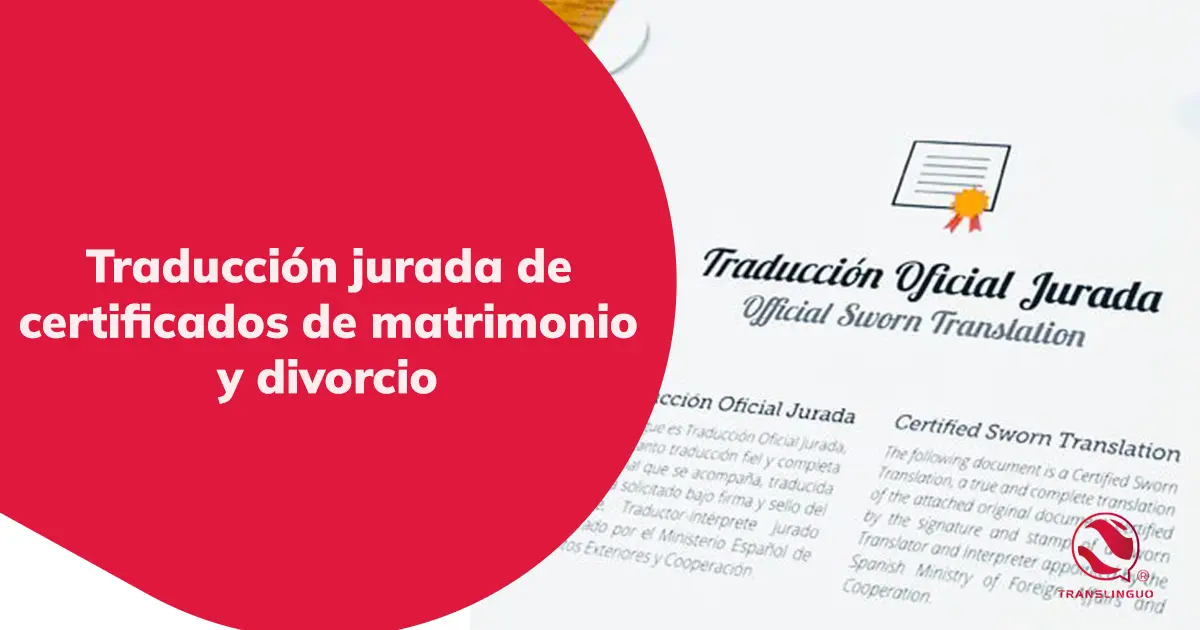
Registering a marriage that took place abroad, registering a divorce decree issued in another country, or providing proof of marital status for notarial matters, inheritance proceedings, or immigration procedures are situations that have one thing in common: the Spanish Civil Registry requires a sworn translation of marriage certificates or divorce decrees carried out by a sworn translator accredited by the Spanish Ministry of Foreign Affairs. Without the official stamp, the document will not be admittted into the case file.
The challenge is that specific requirements – such as which type of certificate to request, whether it must be apostilled beforehand, the format in which it must be presented, and which details must match exactly – vary depending on the country of issuance, the Civil Registry where it will be submitted, and the specific procedure involved. Providing documents without verifying these requirements is the most common cause of requests to remedy deficiencies, delaying by weeks a process that should only take a few days.
In this article, we break down which documents you need, when does an apostille apply, what errors can hold up an application, and how to obtain an official translation of a marriage certificate or a divorce decree so that it is accepted by the Spanish Civil Registry on the first submission. We also explain why working with an official translation agency such as Translinguo Global is essential to ensure your procedures are carried out legally and officially and are not rejected by public administrations or authorities.

When Does the Spanish Civil Registry Require a Sworn Translation of a Marriage Certificate or Divorce Decree?
The Spanish Civil Registry cannot accept documents redacted in foreign languages without a Spanish translation guaranteeing fide A sworn translation of marriage certificates is mandatory if the document has been issued in a foreign language and is being submitted to register, record a marginal annotation, or complete any other procedure that changes a person’s civil status in the Spanish Civil Registry.
There is an exception that often causes confusion: the multilingual certificate issued under the Vienna Convention in 1976. This type of certificate, which has been issued by civil registries of countries that signed the Convention, includes the content in many official languages and can be accepted by the Spanish Civil registry without an additional translation. However, not all registries will accept it consistently, and it only contains basic information from the certificate (name, date, location). If the certificate includes additional notes or the Registry requests the complete document, the sworn translation of the marriage certificate is mandatory.
Can a Multilingual Certificate Always Replace a Sworn Translation?
Not always. The multilingual certificate issued under the 1976 Vienna Convention can replace a sworn official translation of a marriage certificate in procedures where the Civil Registry only takes into account the basic details of the entry (names of the spouses, date, location and registry reference). Full entries, marginal annotations, marriage files with supporting documentation, or any procedure requiring a full certificate of the foreign document, a sworn translation of marriage certificates is the only acceptable option. It is advisable to always check with the relevant Civil Registry before opting for the multilingual certificate to avoid having to repeat the process.
What Documents are Needed to Register or Prove a Foreign Marriage?
The documentation required to register a marriage celebrated abroad with the Spanish Civil Registry varies depending on the nationality of the spouses, the country where it was celebrated, and if there are details that must match previous records on the Spanish Registry. The documents that are commonly requested, and in many cases require a sworn translation of a marriage certificate, are the following:
- Full marriage certificate: the complete document issued by the Civil Registry of the country where the marriage was celebrated, including all the details of the record, as well as the signatures and official stamps of the issuing authority. This is the main document and always requires a sworn translation if its original is in a foreing language.
- Birth certificates of both spouses: in many cases, the Spanish Civil Registry requires full identification of both parties, especially when the details of one of them are not fount in previous records of the Spanish Registry.
- Passports or identity documents: When the name in the marriage certificate does not match other documents, the passport is used to clarify the correspondence between the different spellings of the name.
- Marginal notes on the certificate: If the marriage certificate contains notes in the margin (previous divorce, name change, data correction), they need to be translated in full alongside the main document.
- Previous civil status certificate (if applicable): If one or both spouses have been married previously, the Registry may require documentation that proves the dissolutions of the previous marriage.
To see the detailed process of how to translate a marriage certificate for the Civil Registry, including specific requirements by country of issue, you can check our article on this subject.
Sworn Translation of a Divorce Judgment: When Is It Needed and for Which Procedures?
The sworn translation of a divorce judgment is required in more situations than most people initially realize. A divorce judgment issued in another country, a divorce certificate issued by the Civil Registry of the country in question, or a divorce agreement notarized in another language are documents that may be required for a wide range of procedures, and their validity in Spain depends on whether they are submitted together with a translation stamped by a sworn translator.
The procedures that most commonly require a sworn translation of a divorce decree in Spain are:
- Divorce registration in the Spanish Civil Registry: when the divorce judgment or certificate has been issued abroad and one of the parties is a Spanish citizen or has existing records in the Spanish Civil Registry.
- Marriage registration file for a new marriage in Spain: The Spanish Civil Registry requires proof of previous marital status and the dissolution of any previous marriage before authorising a new application file.
- Immigration procedures: when the divorce affects a residence permit linked to the spouse, a family reunification, or the legal status of minor children.
- Cross-border inheritance and succession: notaries require proof of the marital status of the deceased and the heirs at the time of death. A divorce judgment that is not recognised in Spain can block the inheritance.
- Pensions and benefits: when the amount of a widow’s pension, a spousal maintenance payment, or a child benefit depends on the marital status registered with Social Security or a mutual insurance scheme.
- Change of surname or update of detail on an ID card or passport: if the divorce involves restoring a former surname or details in the Spanish identity documents need to be updated.
Does a Foreign Divorce Judgment Need to Be Recognised First?
It depends on the country where the judgment was issued and the date it was issued. For divorce judgmentes issued in EU countries after the 1st of March 2001, the Council Regulation (EC) No 2201/2003 (Brussels II bis) establishes automatic recognition without the need for any prior procedure. For judgments issued in countries outside of the EU, the exequatur procedure before the Supreme Court may be required for the judgment to be valid in Spain, before being registered in the Civil Registry or used in other proceedings. A sworn translation of the divorce judgment is required in both scenarios as a prior step.
Civil Status Documents, Procedures, and Sworn Translation Requirements
The following table lists the most common civil status documents related to marriage and divorce, the procedures in which they are usually submitted, and whether a sworn translation of marriage certificates or other civil document is required. The exact requirements may vary depending on the destination Civil Registry, the Immigration Office, or the specific notary.
| Document | Common Procedures | Sworn Translation? | Apostille/Legalisation? |
| Full marriage certificate | Civil Registry registration, marriage dossiers, immigration procedures, and inheritance matters | Yes, always. | Yes, if the country is part of the Hague Convention |
| Extract of the marriage certificate | Fast proof of civil status | Yes, unless a valid multilingual certificate is available | Yes, depending on the country |
| Foreign divorce judgment (EU) | Civil Registry registration, new marriage certificate, inheritance matters | Yes, always. | Not required for EU countries (automatic recognition) |
| Foreign divorce judgment (non EU) | Exequatur + Civil Registry registration, inheritance matters, immigration | Yes, always. | Yes, apostille or legalisation depending on the country |
| Divorce certificate (foreign Civil Registry) | Civil Registry registration, new marriage certificate, pensions | Yes, always. | Yes, if the country is part of the Hague Convention |
| Margin notes of the marriage certificate | Registration of supplementary data in the Spanish Civil Registry | Yes, included together with the main document | The ones with the original, it is not apostilled separately |
| Foreign notarial divorce agreement | Inheritance matters, pensions, change of marital property regime | Yes, always. | Yes, apostille or legalisation depending on the country of issue |
Apostille and Legalisation: A Step That Is Often Forgotten
The sworn translation of marriage certificates ensures that the Civil Registry can read and understand the content of the document, but it does not guarantee that the original document is authentic and issued by the competent authority of the country of origin. That’s what the Apostille is for when the issuing country is part of the 1961 Hague Convention, or consular legalisation when it is not.
The procedure is always carried out in this order: first, the Apostille is obtained in the country where the document was issued, and then a sworn translation of the marriage certificate is requested in Spain. Reversing this order – translating first and obtaining the Apostille afterwards – is one of the most common mistakes. If the Apostille is added after translation, the sworn translator has translated a document that was not in its final version, leading to potenrial differences between the apostilled and translated versions.
Which Countries Do Not Require an Apostille for Documents Submitted to the Spanish Civil Registry?
Civil status documents that require submission between Member States of the European Union do not require an Apostille, in accordance with Regulation (EU) 2016/1191 on public documents, which became applicable in 2019. This Regulation removes the Apostille requirement for public documents (birth certificate, marriage, death, marital status, residence, name) issued in one Member State of the EU and presented in another. However, an official sworn translation of the marriage certificate is still necessary if the document is not in Spanish, as the Regulation removes the Apostille requirement but not the need for translation.
Mistakes That Can Block the Civil Registry Application
Most correction requests issued by the Civil Registry in cases involving foreign civil status documentation are due to mistakes that could be prevented by checking the documents before submission. A correction request does not only delays the application – it can also have significant economic and logistic consequences in marriage applications with a set wedding date or inheritance cases with notarial deadlines. These are the most frequent errors that block applications involving divorce or marriage translations:
- Non-sworn translation: a translation carried out by a translator without official accreditation or by a non-accredited agency, where the sworn translator responsible is not included in the Ministry of Foreign Affairs’ official list. In this case, the Civil Registry automatically rejects the document.
- Incomplete or illegible scanned document: cut-off pages, partially visible stamps, Civil Registry official’s signature from the issuing country out of frame. The sworn translator needs to be able to see and translate the entire content of the document, including stamps and notes.
- Name mismatches: the holder’s name appears spelled differently in the marriage certificate, the passport, and in previous records of the Spanish Civil Registry. This is the most common cause for a correction request in bi-national couple cases, where the spelling of names can vary between documents.
- Non-translated marginal annotations: the marriage certificate has a marginal note (subsequent divorce, correction of data, change of name) which the translator omitted as it was considered secondary. The Civil Registry requires a full translation of the document as it is.
- Incorrect or missing Apostille: the document has not been apostilled, or the Apostille has been issued by an authority that is not competent in the issuing country. Each country assigns specific authorities to issue Apostilles; an Apostille issued by a non-competent authority is not valid.
- Incorrect submission format: some Civil Registries require a sworn translation on paper with original signature and stamp, while others accept digital formats with the sworn translator‘s electronic signature. Submitting in paper format where digital is required (or viceversa) can cause delays even if the content is impeccable.
- Expired certificate: civil status certificates have a validity period (usually 6 months from the date of issue). A perfect sworn translation of a marriage certificate that has expired requires obtaining a new one from the Civil Registry of the issuing country.
The Process for Obtaining a Sworn Translation of a Marriage or Divorce Certificate With No Mistakes
The correct order for obtaining an official translation of a marriage certificate or divorce judgment accepted by the Civil registry on the first submission has 4 steps that, if respected, eliminate almost all causes for error correction requests. The order matters: skipping or reversing any of these steps is the most common cause of having to repeat the process from the beginning.
- Step 1 – Obtain the correct document: full literal certificate (not an extract or a multilingual copy if the Registry requires the literal certificate), valid (issued within 6 months in most cases), and with all stamps and signatures od the issuing authority clearly visible.
- Step 2 – Obtain an Apostille or legalise in the country of origin – If the issuing country is part of the Hague Convention, obtain an Apostille there before sending it to Spain. If it is not part of the Convention, obtain a consular legalisation. This step can only be skipped if the document comes from an EU country and is submitted in Spain.
- Step 3 – Commission a sworn translation: send the complete scan of the document in high resolution (minimum 300 dpi) to the translation agency with the sworn translator. Specify the intended procedure so that the translator can adapt the terminology and submission format for the receiving authority.
- Step 4 – Verification and submission: Before submitting the documentation, verify if the holder’s name matched in all of the documents, if the dates are in the correct format, and if the sworn translator‘s stamp and signature are clearly visible and in full on all pages.
You can visit out page of sworn translation of a marriage certificate to see all of the service details, delivery times by language, and the online ordering process. Also, you can read more about the specific requirements in our article on sworn translations of marriage certificates.
Delivery Times, Prices, and Delivery Format
The delivery time for a sworn translation of a marriage certificate or divorce judgment depends on the document’s language, the amount of pages and the urgency of the procedure. The standard turnaround times for the languages most commonly used in the applications to the Spanish Civil Registry – English, French, Italian, German, Portuguese, Arabic, Chinese, Russian, Romanian – are:
- Documents of 1-2 pages (standard marriage or divorce certificate): standard delivery in 24-48 working hours, with possibility for express delivery on the same business day for languages with high translator availability.
- Documents of 3-5 pages (divorce judgments, documents with marginal annotations): standard delivery in 2-3 working days; express service subject to prior consultation.
- Complete case files with multiple documents: quotation and delivery time provided on an individual basis, depending on the volume, number of languages, and combination of documents.
Regarding the delivery format, we offer both paper delivery with the sworn translator‘s original signature and stamp (required for in-person submission at the Civil Registry) and digital delivery with a qualified electronic signature (valid for online procedures and for certain Registries that already accept electronic submissions). If you already have an appointment schedules or a fixed deadline, please indicate it when placing your order so that we can arrange the express service.
Can I order a sworn translation before obtaning an Apostille?
Technically yes, but it is not recommended, The sworn translator translates the document as it is received: if the Apostille is added after translation, the apostilled document will contain additional text (the Apostille’s text) that is not within the translation. Some Civil Registries and notaries require that the Apostille text is also included in the translation. To avoid repeating the translation, the correct order would be to obtain the document’s Apostille first, and then order a complete sworn translation of the marriage certificate, including the Aspotille text.
The correct sworn translation is the one accepted by the Civil Registry on first submission.
The Civil Registry does not accept mistakes: a document with mismatched names, without an Apostille or with a non-sworn translation of the marriage certificate returns to the strating point, with the time and procfessing of the procedure lost. A sworn translation of a marriage certificate or divorce judgment that is accepted is not only well translated, but also delivered in the correct document format, with an Apostille if required, and with information matching the rest of the file.
Understanding the process before starting it – which document should be requested, in which order should it be apostilled and translated, what mistakes to avoid – is what turns a potentially frustrating process into a file that moves forward without interruptions.
If you have the document at hand and want to confirm whether you need an Apostille, what type of certificate is adequate for your procedure and the time frame in which you need it, send it to us together with the type of procedure. In less than 2 hours we will confirm the exact requirements and send you a non-binding quote.
Get in touch and request a free translation quote from our certified sworn translators.
Translinguo Globa, official translation agency.